
TechTorget Copenhagen on 8 October offered an inspiring opportunity to explore how technology is changing legal services. The day began with Nikki Shaver’s presentation, “The Choice Ahead: Rethinking Legal in a Time of Change”, which provided a compelling framework for the discussions that followed.
Her starting point was a question that deserves attention: why rethink a legal business when revenue, demand and profits are growing?
Strong financial performance can make the need for change less apparent. Yet, as Nikki explained, today’s success and tomorrow’s competitive advantage may depend on different capabilities. Positive business indicators can coexist with growing uncertainty about competition, established assumptions and AI’s impact.
Technology is changing the shape of legal work

Nikki Shaver, Legaltech Hub
Comparing Legaltech Hub’s maps of generative AI solutions from March 2025 and September 2026, Nikki illustrated the rapid expansion of the market across research, contracts, documents, knowledge management and legal operations.
The significance extends beyond the number of products. Legal work combines language, knowledge and processes, making it particularly exposed to advances in AI.
However, technological capability and practical adoption remain different things. Having access to powerful tools does not mean that an organisation has integrated them effectively into its work. Legal teams need to consider how these capabilities could reshape their services, workflows and allocation of expertise.
From productivity to economic value
One of Nikki’s most useful observations concerned return on investment. She used an iceberg to distinguish visible productivity improvements from economic effects that remain harder to establish.
Above the waterline were gains in research, drafting and work quality. Below it were questions about winning work, realised fees, write-offs and matter profitability.
Completing a task faster creates an opportunity. Translating that opportunity into better client experiences, lower costs or more profitable services requires deliberate decisions about how the business operates.
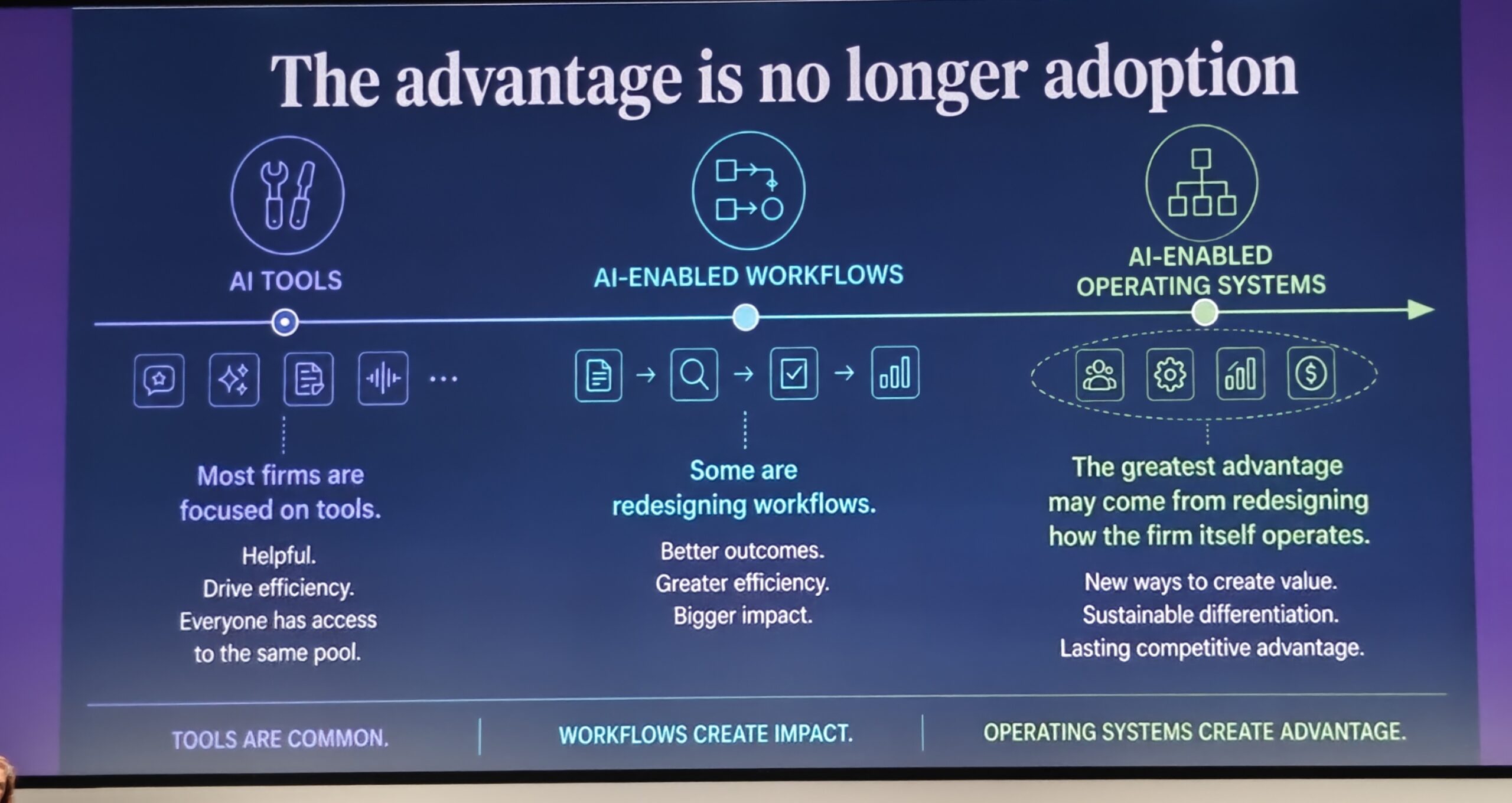
This distinction is central to understanding legal transformation. Accessing technology, improving productivity and creating lasting business value are connected stages, but progress between them requires organisational work.
Capital is accelerating competition
Nikki also highlighted the influence of investment, presenting Legaltech Hub figures showing $4.28 billion in tracked legal tech funding during 2025 and $1.42 billion in the first quarter of 2026.
Capital funds challengers, accelerates experimentation and supports new business models. Meanwhile, competition is expanding beyond specialist legal tech providers to include some of the world’s largest AI and technology companies.

For existing providers and legal organisations, this means that the competitive environment can change even while their own business continues to perform well.
As technological capabilities become more widely available, organisations need to consider where their distinctive value lies, and which knowledge, services and ways of working will make them valuable to clients.
Turning these ideas into practice
The subsequent panel, “Future (Mis)directions for the Legal Sector”, brought together Nikki Shaver, Andrew Hjuler Chrichton and Olivia R Lindersen, moderated by Dorthe Bjerregard-Knudsen.

Dorthe Bjerregaard-Knudsen (DI Professional Services), Andrew Hjuler Crichton (the Danish Bar and Law Society), Nikki Shaver (Legaltech Hub) and Olivia R Lindersen (BechBruun)
The discussion encouraged “opportunity workshops” to identify improvements and workflows suitable for automation. Olivia’s memorable analogy captured the challenge: putting a Tesla in front of a horse buggy makes poor use of its capabilities. Greater change comes from redesigning the process, including its incentives and business model.
Other panels explored the practical consequences. Sophia Lagerholm contributed to discussions about value-based pricing and allocating growing AI costs. Andrea Lindblom moderated a panel exploring how parties’ and legal representatives’ access to AI affects the courts, with more and longer documents being submitted and certain types of cases increasing substantially. The discussion considered how courts should respond to these developments.
Philippa von Seth participated in a discussion about human oversight, accountability and risk, emphasising verification and trust. In the adoption panel, Marion Ehmann highlighted the need to consult clients more and understand their different value drivers. Starting small while thinking big offered a practical approach.
A reflection
Nikki’s presentation gave the day a strong strategic foundation. Today’s success should provide a foundation for building tomorrow’s capabilities: rethinking processes, developing people and applying knowledge through technology. That is how productivity gains can become lasting competitive advantages.