

Last week, the Legal Transformation Network together with Cirio Advokatbyrå hosted a seminar, shaped in collaboration with the law firms Delphi, DLA Piper, Glimstedt, Cirio, and Setterwalls, featuring a presentation by Aku Sorainen. The session built on and deepened the themes from his earlier presentation at TechTorget Stockholm, offering a more detailed perspective on how a data-centric culture can drive performance in law firms.
What emerged was not just a discussion about metrics, but a deeper shift: from measuring performance to enabling better decisions, collaboration, and client outcomes.

The global reality: very different models, same ambition
Across leading law firms globally, partner appraisal systems vary widely, but they reveal some consistent patterns.
In top US firms, often measured by high Profit per Equity Partner (PEP), systems tend to be highly culture-driven, often opaque (“black box” compensation), focused on collaboration and origination and relatively light on explicit KPIs.
In the UK, many firms combine lockstep or hybrid systems, strong peer accountability and selective use of structured evaluation (e.g. 360 reviews, behavioural metrics).
Across Continental Europe and Israel, a broader mix of financial and non-financial KPIs are usedan with an increasing emphasis on firm contribution, collaboration, and role modelling and on the same time an ongoing tension between formal metrics and what “actually matters” in practice.
The Sorainen approach: from KPIs to “data sensors”
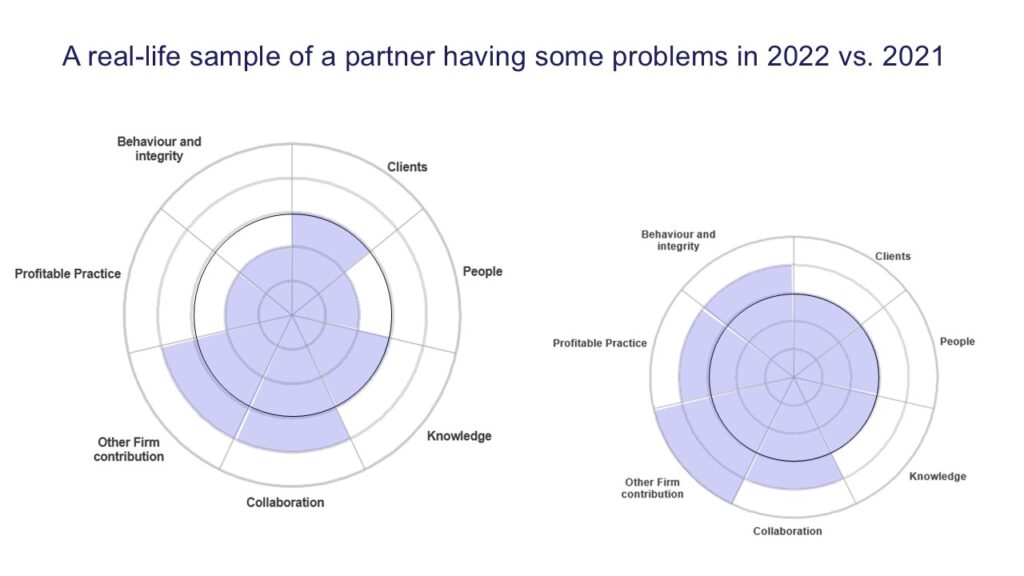
Rather than focusing on a handful of KPIs, Sorainen has developed a holistic, data-centric partner appraisal model built around what they call “sensors.”
These sensors capture both hard (quantitative) and soft (qualitative) data across multiple dimensions:
- Clients: feedback, relationship depth, service penetration
- People: engagement, mentoring, retention
- Knowledge: use of templates, automation, AI, training
- Collaboration: cross-selling, shared work, internal feedback
- Firm contribution: leadership, strategic initiatives
- Financials: profitability, utilisation, realisation
- Ethics & behaviour: values, client selection, role modelling
The purpose is not control. It is context.
Even though the data is used to evaluate partners, the primary objective is to:
- Enable smarter decision-making
- Identify the right opportunities and priorities
- Improve staffing and budgeting
- Strengthen knowledge sharing
- Deliver higher-quality advice
Ultimately: better value for clients, and more satisfied partners.
Culture eats metrics for breakfast
A recurring theme in the presentation echoed Jim Collins and Good to Great:
“Get the right people on the bus… and then figure out where to drive the bus.”
Law firm partners are typically highly self-motivated. The real risk is not lack of incentives, but de-motivation through poorly designed systems.
Overly complex appraisal frameworks, excessive micromanagement, or unclear evaluation criteria can undermine trust, collaboration and long-term firm value
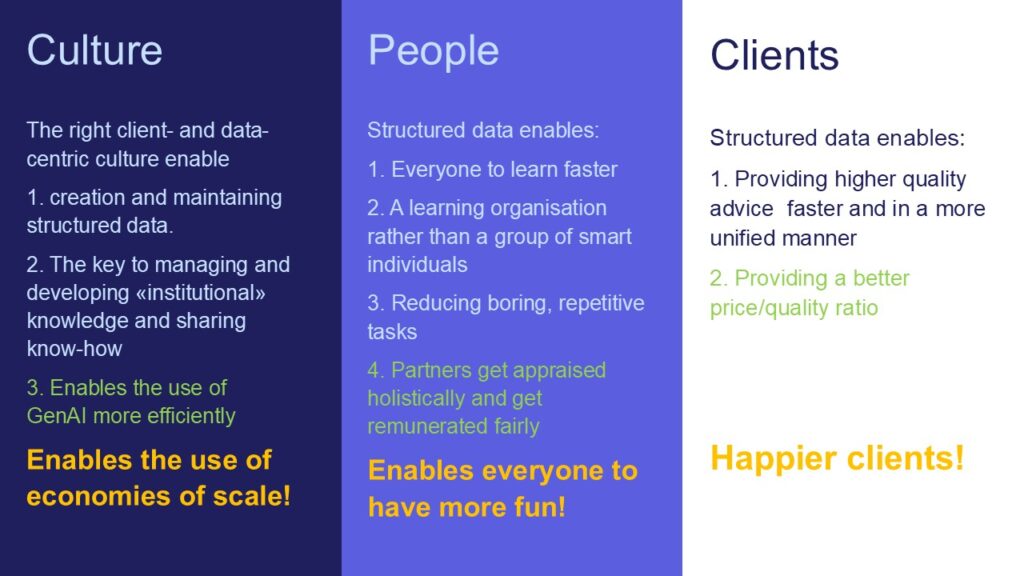
By contrast, a well-structured data environment can reduce uncertainty, increases transparency and align behaviour with strategy
The real shift: from data collection to data culture
Many firms already capture large volumes of hard data (hours, revenue, utilisation). The real challenge lies in soft data such as client insights, knowledge sharing, collaboration quality, mentoring and leadership. This data is harder to capture and is historically undervalued.
Sorainen’s insight is simple but powerful: When data becomes part of how partners are evaluated, it becomes worth capturing. This creates a virtuous cycle in which better data leads to better decisions, better decisions lead to better outcomes, and better outcomes in turn create stronger incentives to share data.
What a data-centric firm actually enables
When structured data is embedded across the firm, entirely new use cases emerge:
- “What should I know before meeting this client?”
- “Which clients should I prioritise today?”
- “How should I staff and price this matter?”
- “Which colleagues should I involve?”
- “How do our business plans align with strategy?”
This is where legal tech becomes meaningful, not as tools, but as decision infrastructure.
The bigger picture: staying in the “prime cycle”
The presentation referenced the Adizes Corporate Life Cycle. In the prime phase, firms are growth-oriented, collaborative, innovative and externally focused. In the decline phase, firms become complacent, focus inward and lose innovation and momentum.
The conclusion was clear: high-quality, structured data helps law firms not only stay in the prime phase longer, but also push themselves back into prime when performance begins to drift.
Conclusion: a holistic approach to performance
If law firms want to build sustainable, high-performing organisations, the lesson is not to optimise a few KPIs. It is to measure broadly, think holistically, align incentives with behaviour and build a culture where data is shared and used.
A data-centric approach does not just improve evaluation. It creates better knowledge sharing, more transparent organisations, stronger collaboration and higher-quality client outcomes. And perhaps most importantly: It enables law firms to move from being collections of talented individuals to becoming true learning organisations.
Legal tech is often framed as a question of tools. But this session made it clear that the real transformation lies in something deeper: how firms structure, share, and act on knowledge.