
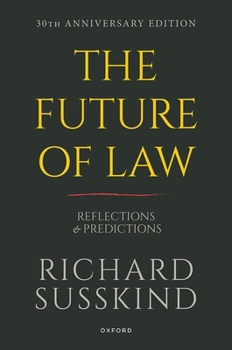
This subject is personal to me. It was Susskind’s 1996 book, The Future of Law, that first inspired me to get involved in legal tech, and it’s shaped how I think about the field ever since. So it felt fitting to recently hear him speak in person at the Legal Revolution conference in Berlin, thirty years on from that original book, watching him return to and sharpen the very ideas that got me started in the first place.
And yet, I believe Susskind’s most important message is that we may still be asking the wrong question.
The more interesting question, then, is not how lawyers can use AI, but rather what legal services we can create now that AI exists. That is a very different starting point, and it changes almost everything about how we should think about legal technology.

Richard Susskind and Helena Hallgarn
From Lawyer Tools to Client Solutions
Legal tech has traditionally been built around the lawyer’s existing workflow, just faster. The real shift happens when we start instead from the client’s actual problem: what genuinely needs human judgment, what can be automated, and where expertise should be built into the process itself rather than applied manually each time. That’s the difference between building better tools and designing AI-enabled legal services.
The AI-Empowered Client
Law firms have always benchmarked against other firms. But clients are now gaining their own AI capabilities; research, drafting, even legal reasoning, meaning more work can be done in-house. The competitive question for firms isn’t “how do we do the same work cheaper with AI,” but “what will clients actually need from us going forward?”
From Products to Service Architecture
The next phase of legal tech isn’t about picking the right point solution. It’s about combining legal expertise, legal engineering, and technology into a layered architecture: expertise defines the outcome, engineering structures it into process, technology scales it, and service design shapes how clients experience it; eventually reshaping pricing, delivery models, and firm structure itself. AI isn’t the transformation; it’s the enabler.
The AGI Question
Susskind does not claim that artificial general intelligence will definitely arrive, or say when it might. What Susskind does insist on is that the legal profession must start thinking through the consequences now, rather than waiting until the technology has already arrived. If AI reaches a level where systems can perform much of the cognitive work currently carried out by qualified lawyers, then a whole set of questions change at once: questions about the shape of the legal market, about access to justice, about the rule of law, and about the very need for lawyers as we understand that role today.
There Is Also an Important Social Dimension
Susskind’s argument is not only about the profitability of law firms. He starts from the observation that today’s justice system, in many areas, simply fails to deliver legal help that is cheap enough, fast enough and accessible enough for the people who need it. Seen from that angle, AI is not only a threat to the legal profession. It is also an opportunity to dramatically improve access to justice for people and businesses who are currently priced out of it or left without adequate legal support altogether.
Two Parallel Tracks for Decision-Makers
Susskind suggests decision-makers plan on two tracks: a 3–7 year horizon focused on incremental change with today’s AI, and a longer view toward 2040 built around a genuinely AGI-shaped legal world; one focused less on lawyers, more on avoiding legal problems altogether.
The Real Shift
Adopting AI assistants isn’t transformation. Transformation happens when legal services are redesigned around what’s now possible. The question worth asking isn’t “how should our lawyers use AI?” but rather; “What should a legal service look like, now that AI exists?”