

What stayed with me after Nordic Legal Tech Day on 7 October was how much of the conversation focused on people, knowledge and processes.
Technology was, of course, central to the day. But the discussions repeatedly returned to the organisational work needed to make it useful. How do we build legal teams that learn? How do we improve our data? How do we design processes that turn technological possibilities into better legal services?
The difference lies in what we build around the technology
 Alexander Irschenberger opened the day with “Building Legal Teams of the Future”. His message put people firmly at the centre: when investing in new solutions, he suggested that 20% of the effort should go into technology and 80% into people.
The precise allocation may vary, but the principle is compelling. Buying a solution is only one part of making it work.
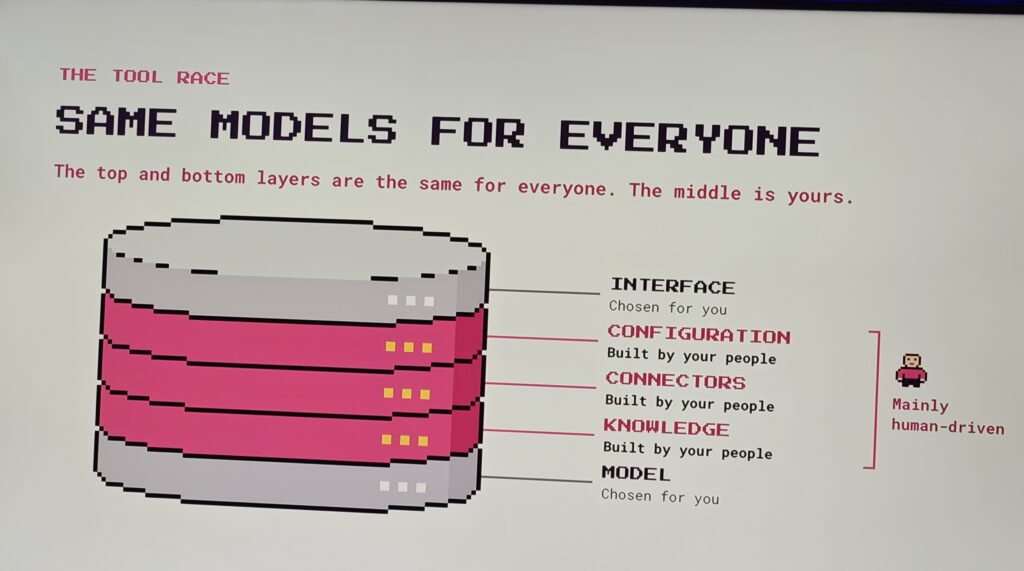
Alexander also made an important point about differentiation. When organisations purchase AI solutions, they often gain access to similar underlying models and interfaces. The technology itself may therefore offer limited competitive advantage.
The distinction comes through configuration, connectors and knowledge: how we adapt the solution, connect it to relevant information and systems, and incorporate our expertise.
That requires a culture of curiosity, learning and sharing. These qualities are not always actively encouraged in legal teams, where individual expertise and established ways of working can carry considerable weight.

It also raises questions about recruitment. Are we hiring for the legal team we have today, or the one we will need tomorrow? And do our interviews help us identify people who can learn, collaborate and rethink how work gets done?
We have tools – Now we need better processes
Another interesting session was “The Agentic Law Department”, featuring Håkan Nordling from Volvo, Ling Wang from Ericsson and Yang Zhang from Stora Enso, moderated by Robert Kuter.

One of Håkan’s strongest messages was that legal organisations already have many of the tools they need. The more pressing problems concern data and processes.
This is an uncomfortable but useful observation. Another technology purchase will not resolve poor data quality, unclear responsibilities or a workflow that nobody has properly examined.
The discussion also highlighted a difference between the visibility of errors in litigation and in contracts. A court submission is scrutinised by opposing counsel and the court. Problems in contracts may remain unnoticed for years, only becoming apparent when a disagreement arises or an obligation needs to be enforced.
That makes the design of our processes particularly important. A convincing document is not, by itself, evidence of a reliable process.
We need clearer legal process models: an understanding of the steps involved, the information required, the decisions to be made and the points at which expert judgement or verification is necessary.
We also need to understand the distinction between stochastic and deterministic models. Generative AI produces probabilistic outputs. Deterministic rules and workflows are appropriate where defined inputs must lead to a consistent, specified result. Neither approach removes the need for sound legal design and validation, but understanding their different roles helps us choose the right method for each task.
The session’s emphasis on “buy, don’t build” fitted well with this broader message. We do not necessarily need to develop the underlying technology ourselves. We do need to configure it around our processes and needs, with subject matter experts closely involved.
And we need to decide what to stop doing. Improving a process should include questioning whether every existing step is still necessary.
Why recognising legal innovators matters
The day concluded with the Legal Innovation Prize, awarded to Håkan Nordling. The jury comprised Ulf Lindén, Miranda Espenäs, Malin Männikkö and Helena Hallgarn from VQ.
The award recognised a combination of achievements: contract automation, AI-driven contract analytics, a clear approach to legal data, and the integration of legal operations thinking into everyday in-house work.
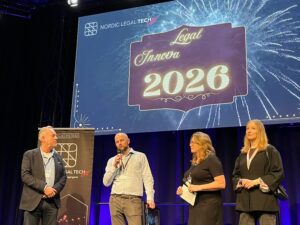
But it also recognised the way Håkan approaches innovation. He starts with the business, the processes and the people. He shares his knowledge generously. And he continues to learn, including through further studies in information systems.
I believe recognising legal innovators is an important part of developing our field. Visible role models make change more tangible. They show colleagues what is possible, provide practical examples to learn from and help broaden our understanding of what a lawyer can contribute.
By recognising both their achievements and their willingness to share, we encourage the behaviours that help the whole profession move forward.
Turning access to technology into an advantage
My main takeaway from the day is that legal tech appears to be entering a more mature phase. More attention is being given to the people and processes that determine whether technology delivers meaningful results.
The next step is to act on that understanding. We need to build our processes, improve our knowledge and data, and make better use of the technology already available to us. This is where we can develop competitive advantages.
Access to powerful tools is becoming increasingly widespread. The advantage will belong to those who learn how to make them work well.